Best HeyFlow Alternatives to Build Quiz Funnels in 2026
HeyFlow became popular because it simplified building multi-step forms without requiring any code. For a lot of teams, especially when first getting started, this solved a genuine issue. You could put together structured workflows, walk users through steps one at a time, and gather data without gett

HeyFlow became popular because it simplified building multi-step forms without requiring any code. For a lot of teams, especially when first getting started, this solved a genuine issue.
You could put together structured workflows, walk users through steps one at a time, and gather data without getting tangled up in overly complex setups.
But then lead generation becomes a serious channel for growth, and many teams hit the same wall.
Costs start piling up fast, they hit usage limits, and the tool starts looking more like a generic flow assembler than a system built to handle landing pages when you need serious volume.
This is usually the period where teams begin their search for other options.
This article looks at the best HeyFlow alternatives available in 2026, with a sharp focus on landing pages for lead generation, not just on building interactive quiz funnels.
The main objective is to determine which systems truly support lead generation as traffic, ad spend, and sales targets rise.
Quick List of HeyFlow Alternatives
- LanderLab: Designed for teams running serious lead generation campaigns. Offers unlimited leads, unlimited quiz funnels, no submission caps, no traffic-based pricing, built-in CRM, OTP verification, email and phone validation, and predictable pricing with no hidden fees.
- Growform: A multi-step form builder focused on conversion-optimized lead capture forms. Well-suited for agencies and teams that want structured forms with conditional logic, though pricing typically scales with submission volume.
- Involve.me: An interactive content platform that supports quizzes, calculators, and surveys. Strong for engagement-focused campaigns, with tiered pricing based on usage and submission limits.
- Perspective Funnels: A mobile-first funnel builder centered on conversational, step-based experiences. Effective for interactive lead capture, with pricing generally tied to traffic and volume tiers.
Why Teams Look for HeyFlow Alternatives
HeyFlow performs quite well when traffic volume is low, and the main objective is getting people to interact.
The piercing points usually surface once campaigns have been running reliably for a while.
One very common problem centers on pricing.
What seemed perfectly fine at the start can change rapidly as the number of views, submissions, or perhaps the active flows increases.
Teams often realize they are paying for more than just the software; they are paying for every single positive indicator of success.
Another significant matter is control itself.
Many teams have discovered they are past just building flows. They are running live landing pages that require proper hosting, full domain ownership, reliable tracking, seamless integrations, and flexibility for years to come, not just now. By then, a tool designed mainly around the concept of a ‘flow’ can feel quite confining.
The question changes from “how quickly can we build a flow?” to something more like “how do we actually run consistent lead generation without getting trapped in a box?”
What to Look for in a HeyFlow Alternative
A proper alternative needs to move beyond just interaction design; it really should. It must treat landing pages as the core asset they are, not just a vessel to hold a series of questions you ask people.
This implies having complete command over the page layout, owning your domains and where they are hosted, having lead capture built in natively, and the ability to filter leads for quality before they even think about reaching the CRM system.
And this also requires a pricing structure that is easy to predict and does not punish success with limits that are hidden or sudden overage charges.
Platforms that view traffic as something to fear, as a liability rather than a sign of growth, typically become a limitation rather than a support to the core business structure.
Best HeyFlow Alternatives Ranked:
LanderLab
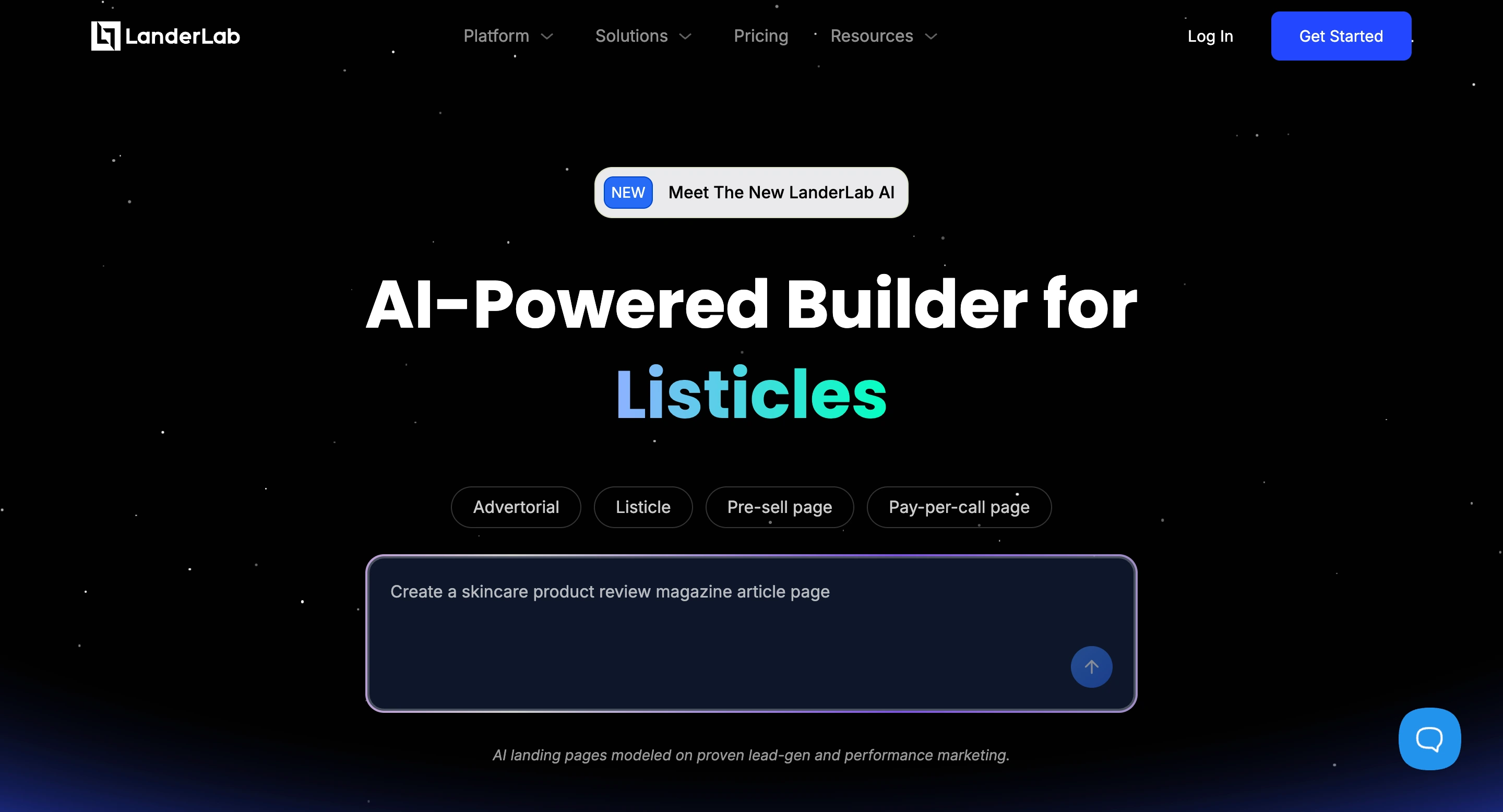
LanderLab is the best HeyFlow alternative in 2026, designed from the ground up for landing pages & quizzes that primarily generate leads.
They use AI, yes, to speed up the creation of the page, but everything that occurs afterwards remains completely under your authority.
Rather than centering the entire product on flows, LanderLab positions the landing page as the core strategy.
Beyond page creation, LanderLab includes the infrastructure needed to run and scale lead generation campaigns without relying on external systems:
- Unlimited leads & unlimited conversions
- Unlimited quiz funnels
- Predictable pricing with no hidden fees or overage charges
- Built-in CRM for managing captured leads
- Partial lead capture
- Email and phone OTP verification to improve lead quality
- A/B testing for optimizing performance
- Native hosting with a custom domain
- AI full-page generation from a single structured prompt
- AI quiz funnel generation, built your flow with AI prompts
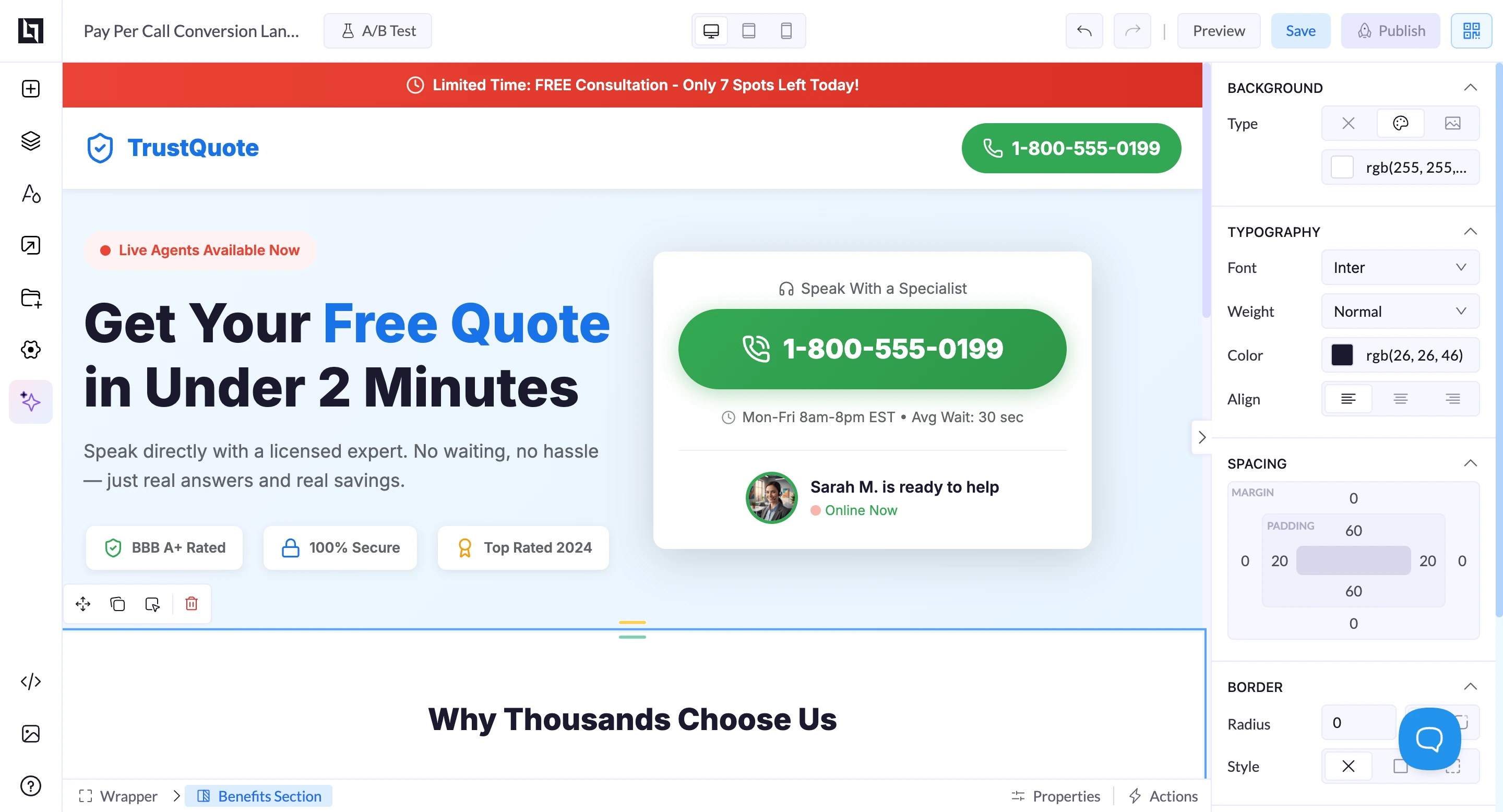
Qualification is managed by being very clear and having a solid structure, not by forcing every visitor into the same standard form layout.
Pages are deliberately set up to manage expectations, clarify user intent, and provide necessary context before a lead is passed to sales.
What makes LanderLab a strong HeyFlow alternative is that, besides standard landing pages, it also supports quiz funnels as part of the landing page itself, not as a separate product.
These quiz-style flows are optional and exist inside the page when they make sense for qualification. You can create them from scratch or generate them with AI in a single prompt.
The AI understands lead generation logic, so it structures the page and the conditional steps in a way that feels intentional instead of random.
Instead of just asking questions for the sake of interaction, the logic follows a clear path. It filters obvious non-fits, captures context that sales actually need, and only then asks for contact details.
All of this happens within one landing page experience, not a disconnected funnel.
This approach gives you flexibility. You can run simple, direct landing pages when speed matters, or introduce conditional logic when lead quality matters more. Either way, the landing page stays in your control.

One of the reasons teams stay with LanderLab is that support rarely becomes a bottleneck.
Issues are addressed with context, urgency, and an understanding of how landing pages function within a broader lead generation system. This keeps campaigns running smoothly and reduces the need for workarounds or pauses during scaling.
LanderLab offers a 7-day free trial with no credit card required.
During the trial, teams get full access to the platform to explore the builder, create landing pages, configure quiz logic, and connect integrations.
Publishing pages is unlocked after the trial, which ensures the evaluation phase is focused on fit and workflow rather than partial launches.
This allows teams to make an informed decision before committing, without pressure or surprise charges.
2. Growform
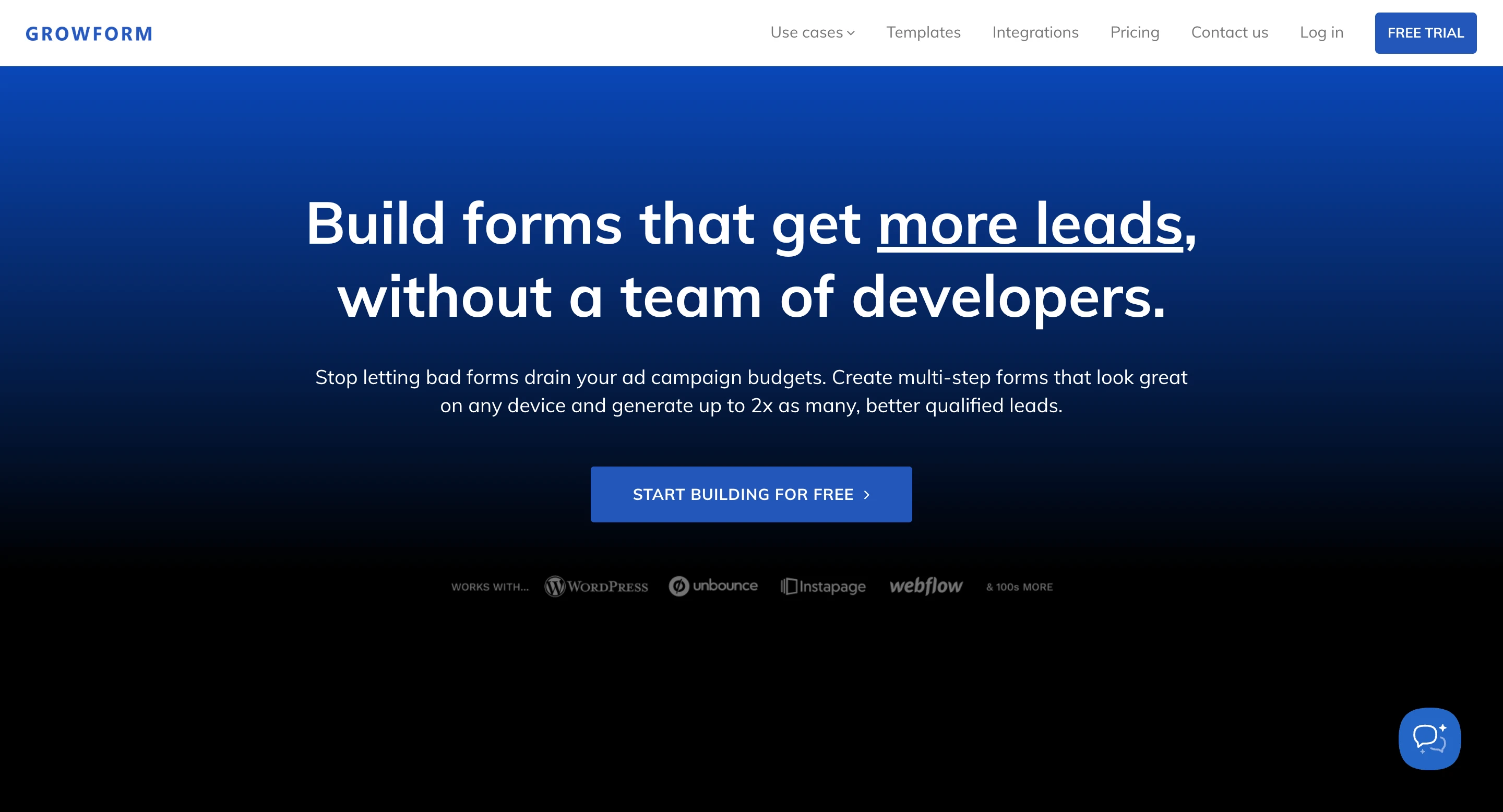
Growform focuses mainly on multi-step lead-capture forms that convert at a high rate, rather than on complete landing page systems.
It is commonly used by agencies and performance marketers who want clean, structured forms embedded in existing landing pages and websites.
Core Focus
- Multi-step forms that have progress indicators
- Conditional logic combined with field branching
- Form analytics as well as conversion tracking
- Easy embedding straight into external landing pages
Strengths
- Well designed multi step form layouts
- Strong conditional logic capabilities
- An agency-friendly dashboard, along with client management
- Integrations using CRM and marketing automation tools
Limitations
- Pricing plans are structured around monthly submission limits
- Higher traffic volumes may require plan upgrades
- Primarily designed for multi-step form creation rather than full landing page infrastructure
- Lead data is typically managed through external CRM integrations
- Limited native AI page generation compared to AI-first landing page builders
Growform works well for teams focused on optimizing form conversions within an existing stack.
For teams that are seeking complete landing page ownership, hosting control, and infrastructural consolidation, additional tools could be required.
3. Involve.me
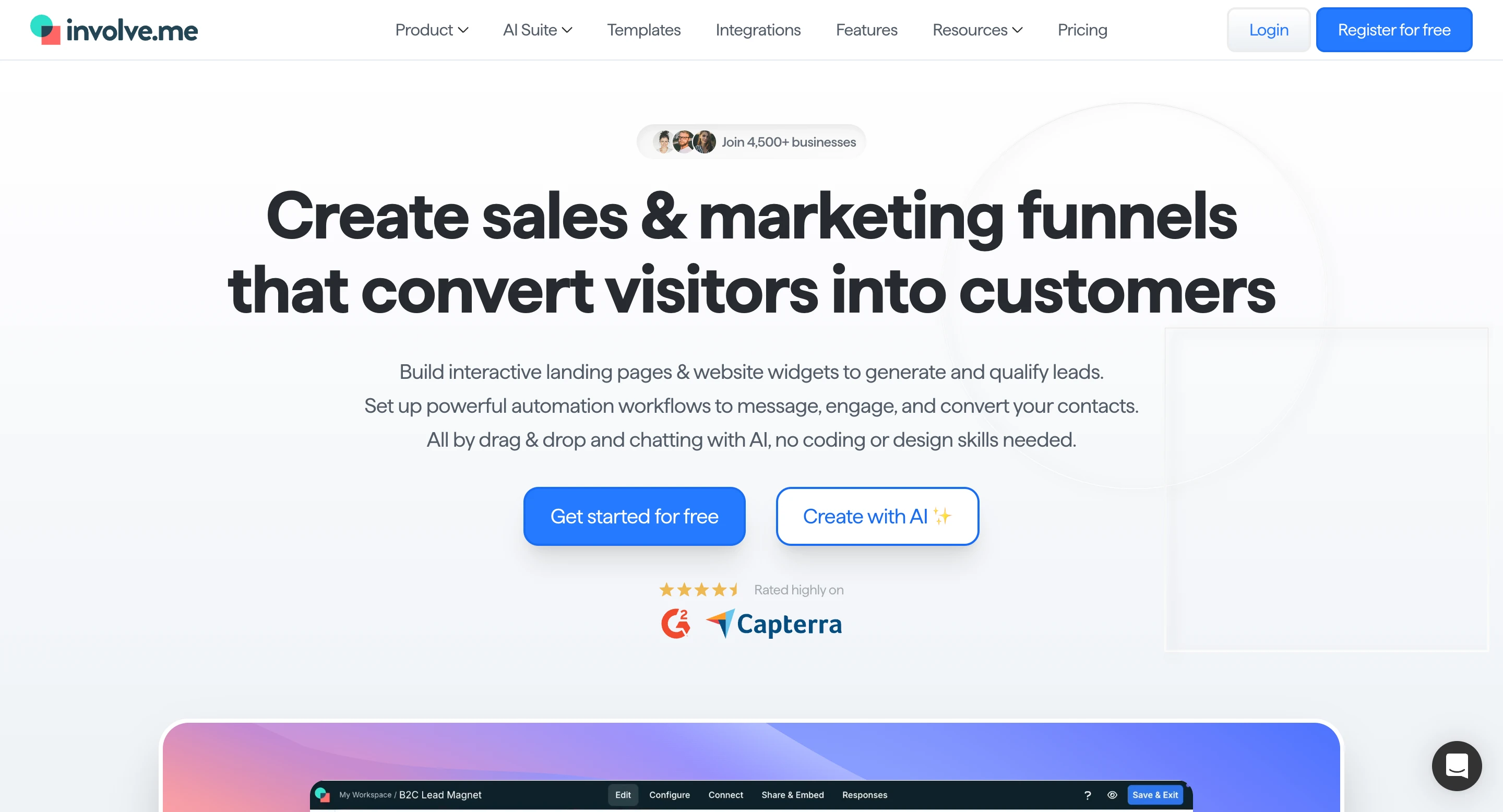
Involve.me positions themselves being a interactive content platform as opposed to a traditional landing page builder.
It supports several interactive formats for engagement and lead capture.
Core Capabilities
- Quiz and calculator builder
- Conditional logic and segmentation
- Hosted landing-style pages
- Email OTP verification
- SMS OTP verification via Twilio integration
- CRM and marketing tool integrations
Strengths
- Flexible interactive content creation
- Strong visual editor
- Multiple interaction formats beyond simple forms
- Broad integration ecosystem
Technical Considerations
- Pricing tiers are structured around response volume
- Monthly submission limits apply depending on the plan
- Often used for interactive campaigns rather than full landing-page-first infrastructure
Limitations
- Pricing plans are structured around monthly response volume, with limits depending on the selected tier
- Higher engagement campaigns may require upgrading to higher-tier plans
- SMS OTP verification requires third-party integration (such as Twilio)
- Primarily optimized for interactive content (quizzes, calculators, surveys) rather than full landing-page-first campaign infrastructure
- Built-in CRM functionality is limited compared to dedicated landing page systems
- Advanced customization and integrations may require higher-tier plans
Involve.me works well for teams focused on engagement-heavy campaigns and advanced interactive logic.
For teams running high-volume paid traffic, response-based pricing should be evaluated against projected campaign scale.
4. Perspective Funnels
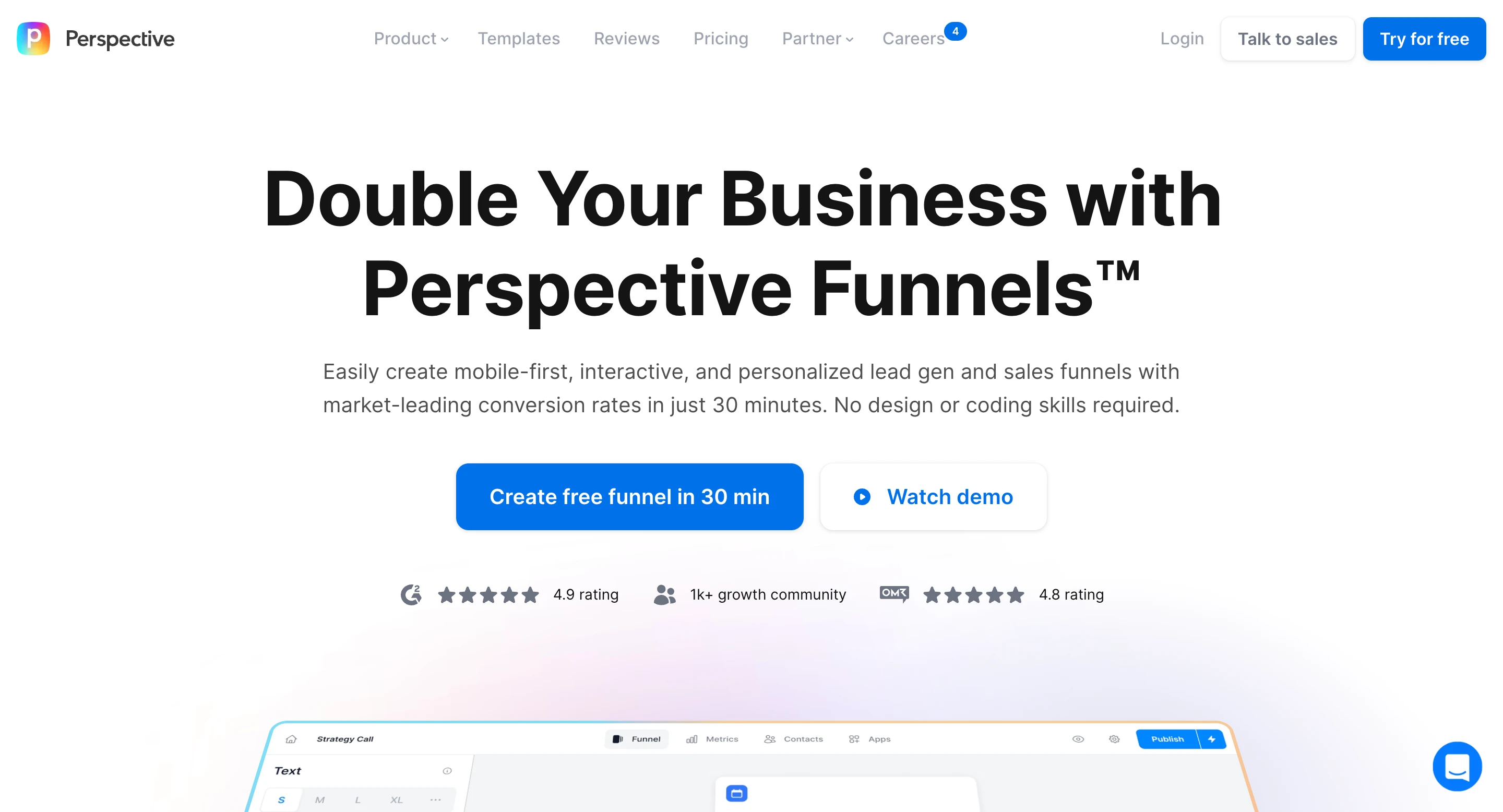
Perspective Funnels is developed around mobile-first, conversational funnel experiences.
It focuses heavily on interactive, step-based flows that are created to mimic chat-like progression.
Core Capabilities
- Step-based conversational layouts
- Mobile-optimized funnel pages
- Hosted funnel infrastructure
- SMS phone verification
- Conditional logic for segmentation
Strengths
- Strong mobile UX
- Quick deployment of flow-style funnels
- Conversational user journey
Technical Considerations
- Primarily structured around flow-based experiences
- Pricing tiers linked to traffic or submission volume
- Lead data is typically routed through integrations rather than a built-in CRM system
Limitations
- Pricing tiers scale with traffic or submission volume
- Primarily designed around conversational flow formats rather than traditional landing page layouts
- Built-in CRM functionality is limited
- Less suited for long-form landing page structures
- May require external tools for deeper campaign management
Perspective Funnels is effective for mobile-first interaction-driven campaigns.
Teams focused on full landing page control, infrastructure consolidation, or unlimited scaling may want to evaluate long-term pricing alignment.
Why Landing Pages Matter More Than Flows
One of the most fundamental errors teams often make is believing they need a quiz setup or a flow tool when the underlying need is simply a superior landing page.
Flows are a tactic, a method used in the moment. Landing pages; they are the real strategy.
A truly effective landing page sets the required context right away, establishes relevance with the visitor, filters their actual intent, and sets expectations before a prospect even bothers to input their contact details.
If that basic foundation is missing, then adding interaction often results only in higher volume, but with lower quality leads coming in. The best HeyFlow alternatives understand this core distinction.
They treat flows and multi-step logic as optional enhancements, not the core product. The landing page remains the primary asset, with interaction used only when it improves relevance or clarity.
Ready to build better landing pages?
If you are evaluating HeyFlow alternatives because your campaigns are growing, LanderLab gives you full control
over landing pages, qualification logic, and integrations, without adding friction as traffic increases.
No credit card required.
How Pricing Impacts Real Lead Generation
The way pricing is structured reveals a lot about the target user the tool was created for.
Most flow-based tools rely heavily on submission caps, view restrictions, or pricing based on interaction volume.
These restrictions are not always transparent when you first sign up for the service. They tend to surface right when campaigns start succeeding, and traffic begins its ascent.
For teams focused on generating leads, this produces friction at the absolute worst possible moment.
Rather than simply scaling up what works well, teams are forced to pause, consider expensive plan upgrades, or even redesign entire campaigns just to work around the pricing limits.
Any platform built for serious lead generation should scale positively with success, not impose a penalty.
Predictable pricing is just as critical as the feature set once your advertisements are running and leads are coming through the door.
When HeyFlow Still Makes Sense
HeyFlow is not inherently a bad product. It is simply optimized for a specific use case.
It can be perfectly acceptable for flows that receive low traffic volumes, for internal administrative tools, for organizing onboarding sequences, or in situations where immediate interaction is more crucial than the overall conversion quality.
For simple surveys or lightweight validation checks, it can remain a decent choice.
The issue starts when people try to use it as the primary engine for serious lead generation when it is really suited for something else entirely.
Final Take on the Best HeyFlow Alternative
HeyFlow is not letting teams down. Teams are simply asking it to operate at a scale it was never designed to support.
As lead generation becomes more competitive, pricing predictability and operational support become just as important as features.
Tools that attach rising costs to traffic or submissions introduce friction at the exact moment campaigns begin to work.
Support that is slow or disconnected from live campaigns compounds that friction even further.
Templates optimize for speed. Flow tools optimize for engagement. Landing-page-first platforms optimize for reliability, control, and outcomes at scale.
In lead generation, the real conversion moment is not a form submission.
It is when a qualified lead reaches the sales team with context, intent, and clear expectations, without pricing constraints or support bottlenecks slowing momentum. That is what modern landing page systems need to deliver.
Ready to switch from HeyFlow?
LanderLab offers landing pages & quiz funnels with AI, all in one place. Unlimited leads, conversion and zero hidden fees.
No credit card required.