Both platforms start at $99. That number tells you almost nothing about what you will pay.
Every Unbounce vs Instapage comparison quotes the entry price and moves on to the editor. But both tools meter you on visitors, both gate A/B testing behind a higher tier, and both behave very differently the month your traffic climbs.
So we skipped the feature list and priced them the way a media buyer would. Three traffic levels, overage included, using each vendor’s published rates. The winner changed at every level.
How we priced it
Every Unbounce vs Instapage figure below comes from the vendors’ own pricing pages, terms and help documentation, read in September 2026. Nothing is estimated between published tiers.
Three rules we held to across all three scenarios:
- The plan has to run ads. That means custom tracking pixels. Unbounce’s $29 Starter plan has none, so it is out of every scenario.
- Monthly billing. Annual figures are noted where they matter, but nobody testing a new stack signs a year up front.
- Overage counts. A price that only holds while you stay under the cap is not a price.
Scenario 1: 15,000 visitors a month, no testing yet
One offer, one domain, one person running it. You need a page that loads fast and a pixel that fires. You are not split testing yet.
Unbounce Build: $99 a month. Unlimited pages, 20,000 visitors, custom scripts and pixels, popups, sticky bars, one seat, one root domain. You have 5,000 visitors of headroom.
Instapage Create: $99 a month. Unlimited pages, 15,000 visitors, tracking scripts, reusable blocks, AI copy, and ten team seats. You have zero headroom.
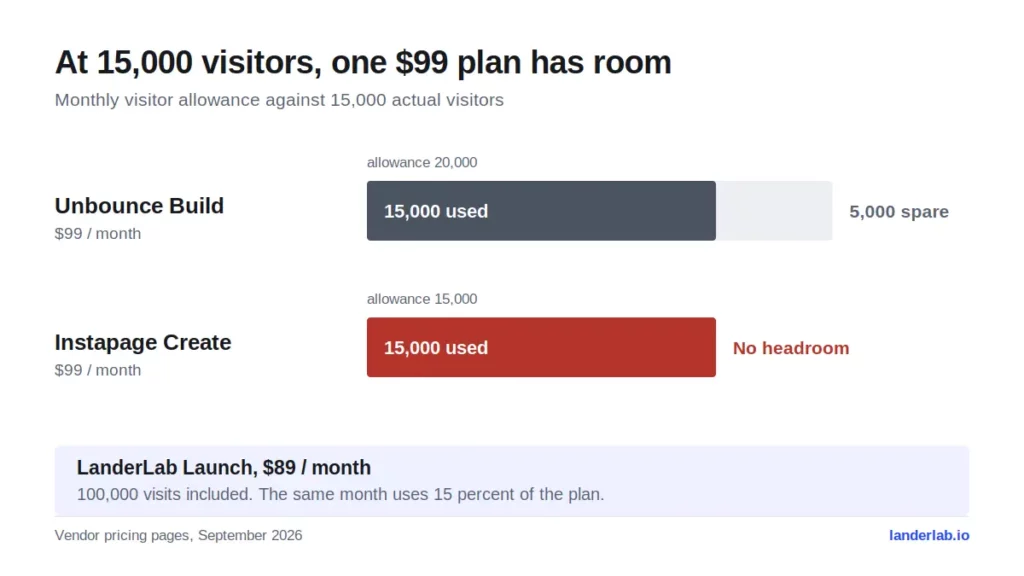
That last point is the whole scenario. At 15,000 visitors you are sitting exactly on Instapage’s ceiling. One good day of traffic puts you over, and Instapage does not bill you for it. It locks the account.
Unbounce is the safer $99 here, purely on the 5,000 visitors of slack. Instapage is the better $99 if you have a team, because ten seats against one is not a small difference.
Scenario 2: 40,000 visitors a month, actively testing
The campaign works. You are running two or three variants against each other and scaling spend. This is where most paid traffic accounts actually live.
Unbounce: $229, or $249 for the better deal. Experiment at $149 unlocks unlimited A/B testing but caps at 30,000. At 40,000 you are 10,000 over, which is one overage block at $80. That is $229 for the month.
For $20 more, Optimize at $249 gives you 50,000 visitors, Smart Traffic, five seats and three root domains. At this traffic level, paying the overage is worse value than upgrading.
Instapage: $199, then a phone call. Optimize at $199 opens server-side A/B testing, dynamic text replacement, multi-step forms and scheduling. Standard usage is 30,000 visitors.
To cover 40,000 you need the expanded usage option at 50,000 visitors. Instapage’s plans page lists that option but does not display its price, so the real number here is a sales conversation.
And you cannot simply run over. There is no published overage rate to pay. Cross the limit and the account locks.
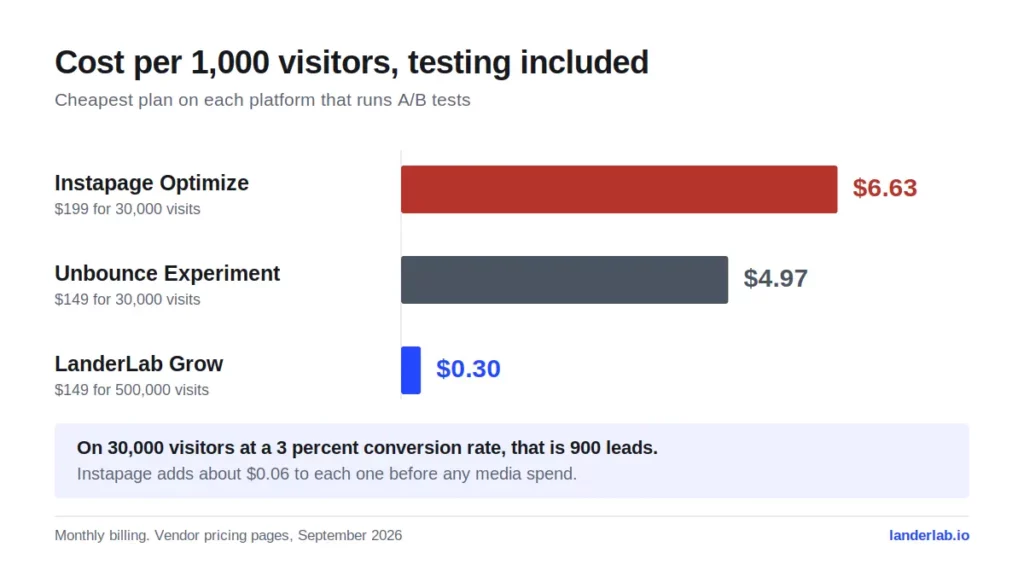
Divide it out and the gap is clearer. At the cheapest plan that runs a test, Unbounce is $4.97 per 1,000 visitors and Instapage is $6.63.
On 30,000 visitors at a 3 percent conversion rate, that is 900 leads. Instapage adds about $0.06 to the cost of each one before you have spent a cent on media. Small, but it is a fixed tax on every lead you buy.
Scenario 3: 90,000 visitors a month
Two or three offers running at once, or one winner you have scaled hard. Nothing exotic. A single well-performing campaign on cheap traffic can produce this in a month.
Unbounce: $569 a month. Optimize is $249 and caps at 50,000. You are 40,000 over, which rounds up to four overage blocks at $80 each, so $320 on top. Unbounce’s own documentation walks through this exact arithmetic.
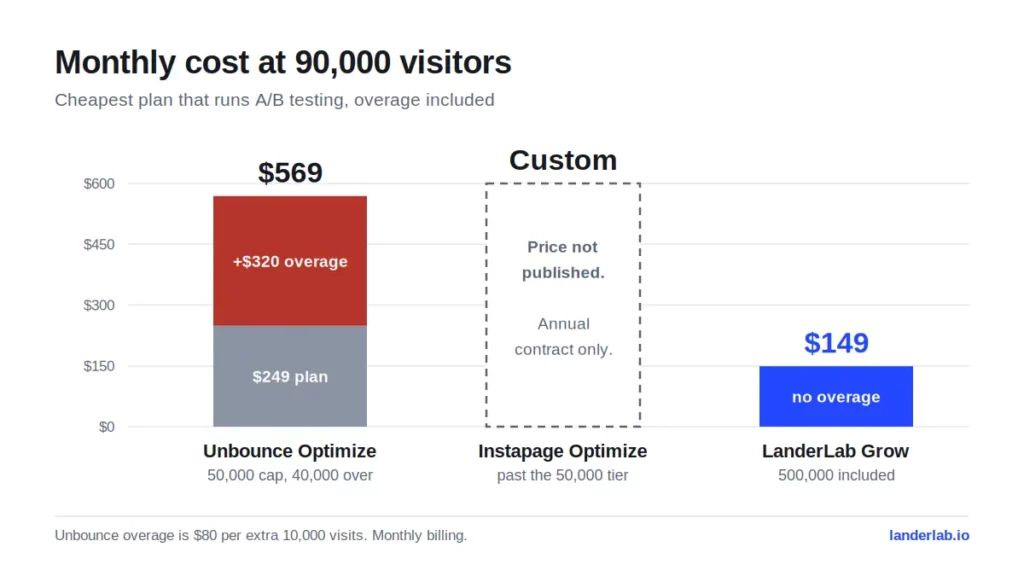
Your pages stay live, which is the important part. But if 90,000 is your normal month rather than a spike, that is $6,828 a year, and you should be talking to Unbounce about a Concierge plan. Those start at 100,000 visitors and are custom priced. Our full Unbounce pricing breakdown goes tier by tier if you want the detail.
Instapage: custom, annual contract only. 90,000 is past the expanded Optimize tier. Instapage will accommodate custom usage above 50,000, but only on an annual contract, and you have to start on expanded Optimize and reach out to sales during your trial.
There is no self-serve path to 90,000 visitors on Instapage. If that is where your traffic is going, factor a procurement cycle into your launch date.
90,000 visits without an overage line
LanderLab Grow is $119 a month billed yearly, with room to scale a winner.
- 500,000 visits a month, not 30,000
- A/B testing included, not a tier up
- 15 custom domains and 3 team seats
Unbounce vs Instapage at three traffic levels
Here is the whole Unbounce vs Instapage comparison at plan level, with LanderLab priced against the same three months.
| Monthly visitors | Unbounce | Instapage | LanderLab |
|---|---|---|---|
| 15,000, no testing | $99 Build, 5,000 spare | $99 Create, at the ceiling | $89 Launch, 100,000 included |
| 40,000, testing | $249 Optimize, or $229 with overage | $199 plus expanded usage, price on request | $149 Grow, 500,000 included |
| 90,000, testing | $569 with overage | Custom, annual contract only | $149 Grow, 500,000 included |
| A/B testing starts at | $149 Experiment | $199 Optimize | $149 Grow |
| Team seats | 1 / 1 / 3 / 5 by tier | 10 on every plan | 3 on Grow, 10 on Scale |
| Domains | 1 / 1 / 2 / 3 root domains | 2 subdomains, 10 on expanded | 5 on Launch, 15 on Grow |
| If you go over | Pages stay live, $80 per 10,000 | Account locked, contact sales | $0.001 per extra visit on Launch |
Prices above are monthly billing, checked on the vendors’ own pricing pages in September 2026. Unbounce takes 25% off for annual, Instapage advertises up to 20%, LanderLab about 20%.
How the free trials compare
The Unbounce vs Instapage trial difference is worth a paragraph, because one of them can charge you before you have finished evaluating.
Unbounce gives you 14 days with no credit card. You get full access to the plan you pick and nothing happens automatically when it ends.
Instapage also gives you 14 days, but it takes your card first and caps the trial at 2,500 unique visitors rather than your plan’s allowance. Hit 2,500 and the trial ends on the spot and your card is charged.
Think about what 2,500 visitors means. On a $200 daily budget at a $0.60 cost per click, that is two days. You cannot run a meaningful test inside that window.
Three things the spreadsheet does not show
The Unbounce vs Instapage math above misses three costs that do not appear on any invoice.
1. A locked account has no line item
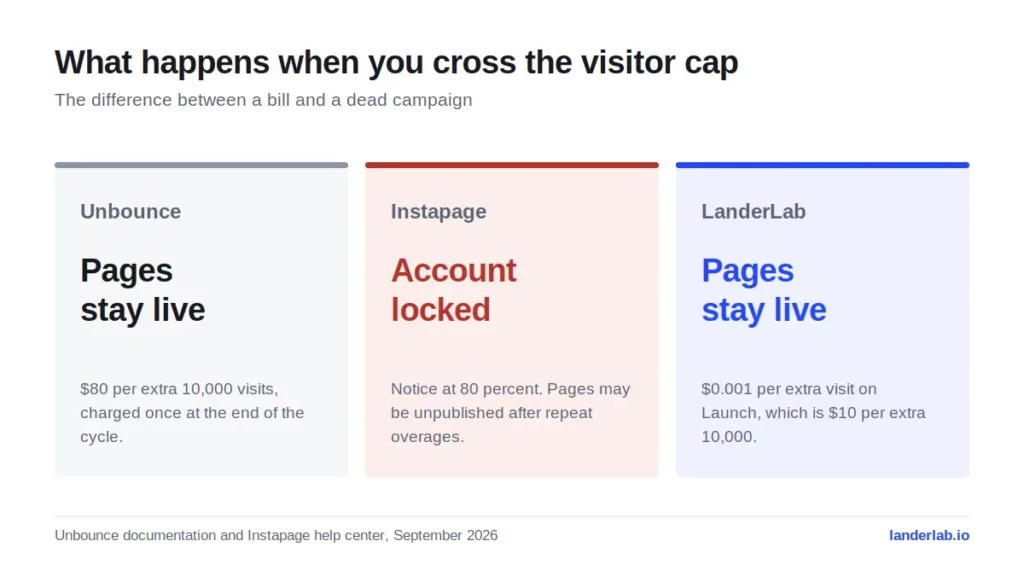
Instapage warns you at 80 percent of your allowance. Past 100 percent the account locks, and pages may be unpublished if you go over across multiple billing cycles.
Price that at your own numbers. If you spend $400 a day and your pages go dark on a Friday evening, the weekend costs you more than a year of either subscription.
Unbounce’s $80 blocks look expensive next to that. They are not. A bill is recoverable.
2. Seats change who can actually work
Instapage includes ten team members on every self-serve plan. Unbounce gives you one seat on Build, three on Experiment and five on Optimize.
If a designer, a buyer and a copywriter all need access, Instapage at $99 is genuinely better value than Unbounce at $99. That is the strongest argument in Instapage’s favor and it is a real one.
3. Both stop at the form submit
Neither platform has quiz funnels. Both have multi-step forms, which is not the same as a branching quiz with conditional logic and per-step drop-off data.
Neither routes a lead to a buyer. If you sell to LeadProsper, LeadsPedia, Phonexa or LeadByte, or run pay-per-call campaigns through Ringba or Retreaver, you are adding Zapier, a webhook layer, or a developer.
Neither imports a page from a spy tool. If your workflow starts in Adplexity or Anstrex, you rebuild by hand. Our roundup of ad spy tools covers where most media buyers start.
Add those three gaps up and the tool bill is not the whole bill. That belongs in the same spreadsheet.
Where LanderLab lands in the same math
Both sides of the Unbounce vs Instapage comparison leave the same gap. LanderLab was built for the paid traffic case rather than adapted to it, which changes what is included and what is metered.
Traffic you can plan for. The Launch plan is $89 a month, or $69 billed yearly, and includes 100,000 visits. All three scenarios above fit inside the entry plan on traffic alone. If you do go over, the overage rate is published: $0.001 per extra visit on Launch, which works out to $10 per extra 10,000 visits against Unbounce’s $80.
Testing at the entry of the range. A/B testing starts on Grow, at $149 a month or $119 billed yearly, along with 500,000 visits, 15 domains, 3 seats, and API and MCP access. Instapage asks $199 for 30,000 visits.
Domains at the entry tier. Launch includes 5 custom domains, against 1 on Unbounce Build. Extra domains are $5 a month each rather than a plan upgrade.
Quiz funnels, unlimited, on every paid plan. Build a multi-step quiz funnel with drop-off analytics per step, so you can see which question loses people instead of guessing.
Import instead of rebuild. The page importer pulls a page in from a URL, a ZIP file, or directly from Adplexity and Anstrex. For anyone who researches offers before building, that is hours back per campaign.
The lead actually goes somewhere. There are 28+ native integrations, including the Meta Pixel and the Meta Conversions API for server-side events, TikTok, Snapchat, Taboola and NewsBreak pixels, Voluum, RedTrack and ClickFlare for tracking, and direct lead distribution to LeadProsper, LeadsPedia, Phonexa and LeadByte. Ringba and Retreaver handle inbound calls.
A free plan that publishes. 2,500 visits, 5 published pages, 1 custom domain, 1 quiz funnel and unlimited leads, forever, with no card. Unbounce gives you 14 days. Instapage gives you 14 days and takes your card first.
Where LanderLab does not win: it has no equivalent of Smart Traffic, no built-in heatmaps, and A/B testing is not on the Launch plan. If AI traffic routing is the reason you were considering Unbounce Optimize, that is a fair reason to pay for it.
The Unbounce vs Instapage verdict, by traffic level
- Under 20,000 visitors, one person, no testing: Unbounce Build at $99. The headroom is worth more than extra seats if you are working alone.
- Under 15,000 visitors, team of three or more: Instapage Create at $99. Ten seats and the collaboration tools are a real advantage, and at that traffic the cap holds.
- Spiky traffic you cannot forecast: Unbounce, at whatever tier. It is the only one of the two that keeps your pages live when you are wrong about the number.
- Multiple offers, multiple domains, lead gen: neither, on cost per visitor alone. Look at LanderLab or another tool built for the volume.
If you want the full tier-by-tier detail on either one, we have a separate breakdown of Instapage pricing to sit alongside the Unbounce one above.
FAQ
How much is the Unbounce overage fee?
Unbounce charges $80 for every additional 10,000 visits, or any part of 10,000, as a one-time charge at the end of the billing cycle. The rate took effect on 10 November 2025. Their own worked example: 85,000 visitors on the 50,000 Optimize plan is a $320 charge. Your pages keep running while this happens.
Does Instapage charge an overage fee?
Instapage does not publish an overage rate. Instead you see a notice at 80 percent of your visitor allowance, and once you pass 100 percent your account is locked. Landing pages may be unpublished if you exceed the limit across multiple billing cycles. The resolution is contacting sales to upgrade your plan.
Which is cheaper at the same traffic level?
It depends on the level. At 15,000 visitors both are $99, but Unbounce gives you 20,000 of allowance for it. At 30,000 with A/B testing, Unbounce Experiment is $149 and Instapage Optimize is $199, so Unbounce is about 33 percent cheaper for the same job. Above 50,000 Instapage moves to custom pricing on an annual contract, while Unbounce stays self-serve with a published overage rate.
Is there a free trial for either one?
Both offer 14 days. Unbounce does not ask for a credit card. Instapage does, and its trial is capped at 2,500 unique visitors rather than your plan’s allowance. Hit that cap and the trial ends immediately and your card is charged for the plan you selected. Neither platform has a free forever plan.
Do Unbounce or Instapage have quiz funnels?
No. Both build single landing pages with forms. Unbounce has multi-step forms on Build and above, and Instapage has them on Optimize, but a multi-step form is not a branching quiz with conditional logic and per-step drop-off analytics. For multi-step lead qualification you need a funnel builder.
What does the Unbounce vs Instapage decision come down to?
Two questions. How predictable is your traffic, and how many people need access. Unpredictable traffic favors Unbounce, because going over the cap costs money rather than uptime. A team of three or more favors Instapage, because ten seats are included on every plan against one seat on Unbounce Build.
Run your own numbers
Open last month’s analytics and write down one number: unique visitors across every landing page you run.
Add 40 percent, because you are reading this to scale, not to stay flat. Then price all three tools against that figure, overage included. Our free ROAS calculator helps if you want to work backwards from margin.
The Unbounce vs Instapage answer is not fixed. It moves with that one number, and the tool that looks cheapest at the top of the pricing page is rarely the one you end up paying for.
Stop budgeting around a visitor cap
Build the page, split test it, route the leads, and scale the winner without an overage line.