Landing Page vs Website: What to Use When You’re Running Paid Ads
If you are running paid ads, the page you send traffic to is one of the highest-leverage decisions in the campaign. Not the bid strategy. Not the audience. Not the creative. The destination. Most teams default to their website because it already exists. That default costs them conversions every day.

If you are running paid ads, the page you send traffic to is one of the highest-leverage decisions in the campaign. Not the bid strategy. Not the audience. Not the creative. The destination.
Most teams default to their website because it already exists. That default costs them conversions every day.
This is not a philosophical debate about which is “better.” It is a practical question with a practical answer that depends on what you are advertising, who you are advertising to, and what you want them to do when they arrive.
Here is how to think about it.
What Is the Actual Difference?
A website is a multi-purpose destination. It has navigation, multiple pages, multiple goals, and multiple audiences. The homepage introduces the brand. The about page builds credibility.
The blog educates. The pricing page converts buyers who are already convinced. A website is designed to serve everyone who arrives, regardless of where they came from or what they came for.
A landing page is a single-purpose destination. It has one offer, one message, one call to action, and no navigation.
Every element on the page exists to move the visitor toward that one action. Nothing else.
That distinction matters enormously for paid traffic because of how people arrive.
Someone who clicks a paid ad has already expressed a specific intent. They saw a specific message, decided it was relevant to their specific situation, and clicked. They are not browsing. They are not exploring.
They arrived with a specific expectation of what they would find.
A website meets that visitor and immediately offers them twelve other things to do. A landing page meets that visitor with exactly what they came for.
Why Sending Paid Traffic to a Website Hurts Conversion
Stripping a landing page of its navigation doubles its conversion rate, one of the most consistent findings in landing page CRO research. That single finding from VWO’s research tells you everything you need to know about why websites underperform for paid traffic. Navigation is not just a distraction. It is an exit ramp.
Every link in your header is an opportunity for a visitor to go somewhere other than where you need them to go.
When you send paid traffic to your website, you are paying for clicks and then immediately offering those visitors reasons to leave before converting.
The other problem is message match. Your ad makes a specific promise. If the page the visitor lands on does not immediately reflect that same promise, the visitor’s trust erodes in seconds.
A visitor who clicked an ad about “free roof inspection for Denver homeowners” and lands on a generic home services homepage has to work to find what they were promised. Most do not bother. They leave.
Sending paid traffic to a generic page that does not match the user’s search intent and does not make the next step obvious is one of the most common and expensive mistakes in paid advertising.
When a Landing Page Is the Right Choice
For paid traffic, a dedicated landing page is almost always the right choice. Here is when it is essential:
Lead generation campaigns. Any campaign where the goal is a form submission, a phone call, or a booked appointment.
Home services, solar, insurance, legal, healthcare, and any other vertical in which you collect contact information from prospects. A dedicated landing page with a single form and no navigation consistently outperforms a website contact page or homepage for this goal.
Single-offer promotions. A limited-time discount, a free trial, a specific product bundle. The landing page matches the ad exactly and removes all paths to distraction.
Quiz funnels. Multi-step qualification funnels that route visitors to personalized results or offers based on their answers. See how quiz funnels work in practice for lead gen verticals.
These cannot be built on a standard website page without significant custom development. A purpose-built landing page or quiz funnel builder handles this natively.
High-volume campaigns where message match matters. If you are running multiple ad groups targeting different audiences with different messaging, each needs its own dedicated landing page that matches the specific ad. Sending all of them to the same website homepage means none of them match perfectly.
Any campaign where conversion tracking requires a unique URL. Google Ads conversion tags and Meta Pixel Lead events fire on a specific URL.
A dedicated thank you page after a landing page form submission is the most reliable way to track conversions accurately.
A modal popup on a website does not give you a unique URL and breaks attribution. See our full guide on thank you pages and conversion tracking for how to set this up correctly.
When a Website Is the Right Choice
There are situations where sending traffic to your website makes more sense than a dedicated landing page.
Brand search campaigns. Someone who searches for your brand name by name is already familiar with you. They want to explore the full brand experience. Send them to your homepage or a relevant product page, not a stripped-down landing page that removes context they are actively looking for.
Awareness campaigns with no immediate conversion goal. If the objective is brand familiarity or content consumption rather than a direct action, the website is the right destination. Landing pages are optimized for a single action. If there is no single action to optimize for, the website serves better.
Retargeting campaigns for warm audiences. Visitors who have already been to your site and are coming back understand the brand context. They are past the awareness stage. They have seen your brand, considered your offer, and left without converting. What they need now is not a stripped-down page that removes context.
They need detail, specifics, pricing, and proof. A full product page or pricing page serves that need better than a landing page that removes everything except one CTA. The landing page was right for the first visit. The product page is a good fit for the return visit.
B2B campaigns where the buying decision requires research. Complex enterprise purchases involve multiple stakeholders, long decision cycles, and significant due diligence.
A VP of Operations evaluating your software does not want to land on a page with one button and no navigation. They want to explore case studies, read technical documentation, understand pricing tiers, and assess the product’s credibility before they ever talk to a sales rep. The website supports that research process.
A landing page cuts it short. For this audience, forcing a single conversion action too early in the process produces low-quality leads who are not ready to buy.
PR, partner, and recruitment traffic. Traffic arriving from press coverage, partnership referrals, or job postings is not paid traffic in the traditional sense. These visitors have different intentions: they want to understand the company, not complete a specific transaction.
A journalist researching a story, a potential partner evaluating a collaboration, or a candidate considering a job application all need the full website experience. Sending them to a stripped-down landing page creates a poor first impression of the brand.
The Conversion Rate Difference Is Real
Dedicated landing pages consistently outperform general website pages in conversion rate. Cross-industry landing page conversion rate data shows dedicated pages converting at roughly double the rate of general website pages, with the gap varying significantly by vertical, traffic source, and offer type.
That gap is not explained by traffic quality alone. It is the structural difference between a page designed to do one thing and a page designed to do everything.
For a campaign sending 5,000 visitors a month to a website with a 2.35% conversion rate, that is 118 conversions. The same traffic to a dedicated landing page at 4.02% is 201 conversions. At the same ad spend. The only variable is the destination.
What the Conversion Rate Difference Means for Your Campaign
The math is straightforward. Here is what a 2x improvement in conversion rate produces across three common campaign spend levels, assuming a website CVR of 2% and a landing page CVR of 4%.
Monthly Ad Spend | Monthly Visitors | Website Leads (2% CVR) | Landing Page Leads (4% CVR) | Extra Leads / Month | CPL: Website vs Landing Page |
|---|---|---|---|---|---|
$4,000 | 2,000 | 40 | 80 | +40 | $100 vs $50 |
$10,000 | 5,000 | 100 | 200 | +100 | $100 vs $50 |
$20,000 | 10,000 | 200 | 400 | +200 | $100 vs $50 |
Same spend. The only variable is the destination.
What the Conversion Rate Difference Looks Like in Practice
The gap between landing page and website conversion rates is not abstract. Here is what it looks like across the verticals where paid traffic is most commonly used.
Home services (roofing). A roofing company running Google Ads sends traffic to its website homepage. The homepage has navigation, a services menu, an about page link, and a generic “Get a Free Quote” form buried below the fold.
The visitor who clicked an ad promising “Free roof inspection in Denver, response within 2 hours” arrives and has to search for that specific offer. Most leave.
A dedicated landing page with that exact promise in the headline, a three-field form above the fold, and no navigation keeps the visitor focused on one action.
The conversion rate difference between a well-optimized landing page and a homepage for this type of campaign routinely runs 2-4x.
Solar lead generation. A solar company runs Meta ads targeting California homeowners. The ad mentions a $0 installation program for qualifying homes. The website’s homepage covers the company’s history, awards, and service areas. The visitor who expected to find out if they qualify instead finds a company profile.
A dedicated landing page that opens with “Find out if your California home qualifies for $0 solar installation” and captures the visitor’s electricity bill in a three-question quiz gives them exactly what the ad promised.
The quiz funnel also captures qualification data that makes the follow-up call more productive.
Insurance and Medicare. A Medicare supplement advertiser runs Google Ads targeting searches like “Medicare plan comparison.” The homepage covers all insurance products: auto, home, life, and Medicare.
The visitor who came specifically for Medicare has to navigate to find it. A dedicated landing page focused exclusively on Medicare plan comparison, with a compliance statement at the top and an age-specific lead form, addresses the visitor’s specific need without distraction.
The compliance statement (“Your information will never be sold to third parties”) addresses the primary objection that causes insurance leads to abandon before submitting.
Legal services. A personal injury law firm runs ads targeting accident victims searching for representation. The website homepage features the firm’s full practice areas: criminal defense, family law, personal injury, and employment law.
The visitor who needs a personal injury attorney has to identify the right practice area before they can find the relevant contact form.
A dedicated landing page that opens with attorney-client privilege stated explicitly, a named attorney’s photo and credentials, and a single form for case evaluation converts at a significantly higher rate because it addresses the visitor’s specific situation without requiring them to navigate.
The Message Match Problem
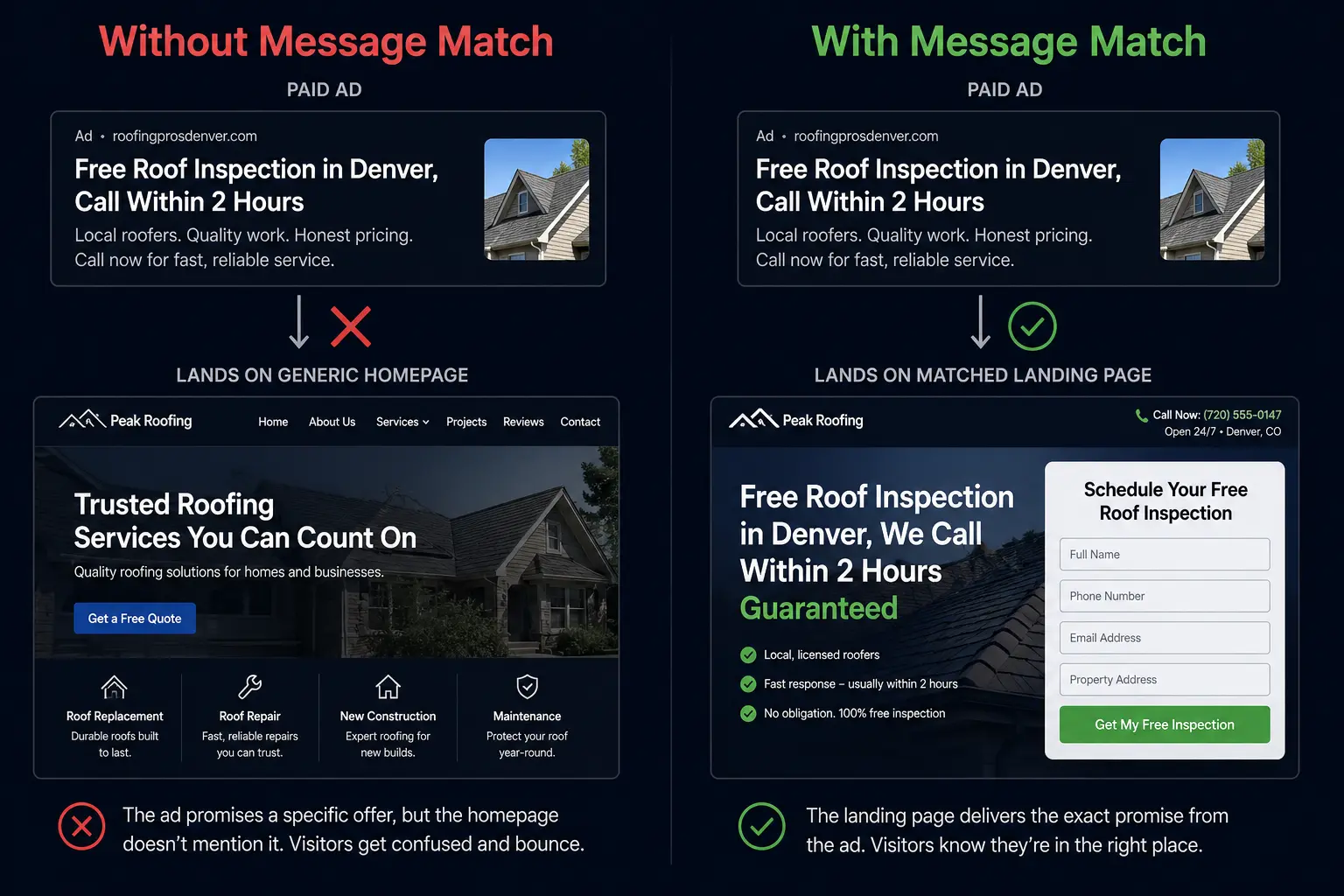
Message match is the alignment between what your ad promises and what your landing page delivers. It is one of the most consistent predictors of landing page conversion rate and one of the most commonly ignored.
A visitor who clicked an ad that said “California homeowners: find out if you qualify for $0 solar installation” and lands on a generic solar company homepage has to search for the specific offer they were promised. Their confidence drops immediately. The page they expected did not appear.
The same visitor arriving on a landing page that opens with “California Homeowners: Find Out If You Qualify for $0 Solar Installation” in the headline has their expectation confirmed in under a second. The trust built by that match is significant.
Dedicated landing pages make message match possible at scale. If you are running five ad sets with five different messages, you can have five landing pages, each matching one of those messages precisely.
A website cannot do this without significant custom development.
What About SEO? Do Landing Pages Rank?
Generally not, and they should not be trying to. Landing pages built for paid traffic should almost always be set to noindex to prevent them from appearing in organic search results.
A landing page that ranks organically receives traffic from people who never clicked your ad. Those visitors arrive without the context your ad provided, which means the message match that makes the landing page work for paid traffic does not exist for organic visitors.
They land on a stripped-down page with no navigation and often find it confusing.
More importantly, if a landing page is indexed, it can fire your conversion tracking tags on non-conversion visits from organic traffic, corrupting your campaign attribution data.
For organic search, your website’s content pages and service pages are the right destination. For paid traffic, dedicated landing pages are the right destination. The two should stay separate.
What the Conversion Rate Difference Means for Your Campaign
Use this calculator to see how much the destination page affects your lead volume at your current ad spend.
The math is straightforward. Here is what a 2x improvement in conversion rate produces across three common campaign spend levels, assuming a website CVR of 2% and a landing page CVR of 4%.
Monthly Ad Spend | Monthly Visitors | Website Leads (2% CVR) | Landing Page Leads (4% CVR) | Extra Leads / Month | CPL: Website vs Landing Page |
|---|---|---|---|---|---|
$4,000 | 2,000 | 40 | 80 | +40 | $100 vs $50 |
$10,000 | 5,000 | 100 | 200 | +100 | $100 vs $50 |
$20,000 | 10,000 | 200 | 400 | +200 | $100 vs $50 |
Same spend. The only variable is the destination.
Landing Page vs Website: The Decision Framework
Situation | Send Traffic To | Why |
|---|---|---|
Lead gen campaign (form, call, appointment) | Landing page | Single form, no navigation, message matches ad exactly |
Brand search campaign | Website homepage | The visitor wants to explore the full brand experience |
Single-offer promotion | Landing page | Removes all distractions, one offer, one CTA |
Awareness campaign, no direct conversion goal | Website | No single action to optimize for, the website provides context |
Multiple ad sets with different messages | Dedicated landing page per ad set | Each page matches its specific ad message precisely |
Retargeting a warm audience | Product or pricing page | Past the awareness stage, needs detail to decide |
Quiz funnel campaign | Dedicated quiz funnel | Multi-step qualification with personalized results requires a purpose-built tool |
B2B campaign, long decision cycle | Website | Multiple stakeholders need to research the website supports that |
How to Build Landing Pages for Paid Traffic Without a Developer
The practical barrier to using dedicated landing pages for every paid campaign used to be the build time. A web developer, a design brief, a review cycle, and several days or weeks before the page was live.
By the time the page launched, the campaign had already been running to the wrong destination.
AI landing page builders eliminate that barrier. LanderLab generates a complete landing page or quiz funnel from a single prompt, including copy, layout, form, and thank you page, ready to publish without touching code.
See a full comparison of landing page optimization tools if you are evaluating which builder fits your operation. You describe the campaign, the audience, the offer, and the vertical, and the AI produces a page matched to those parameters in minutes.
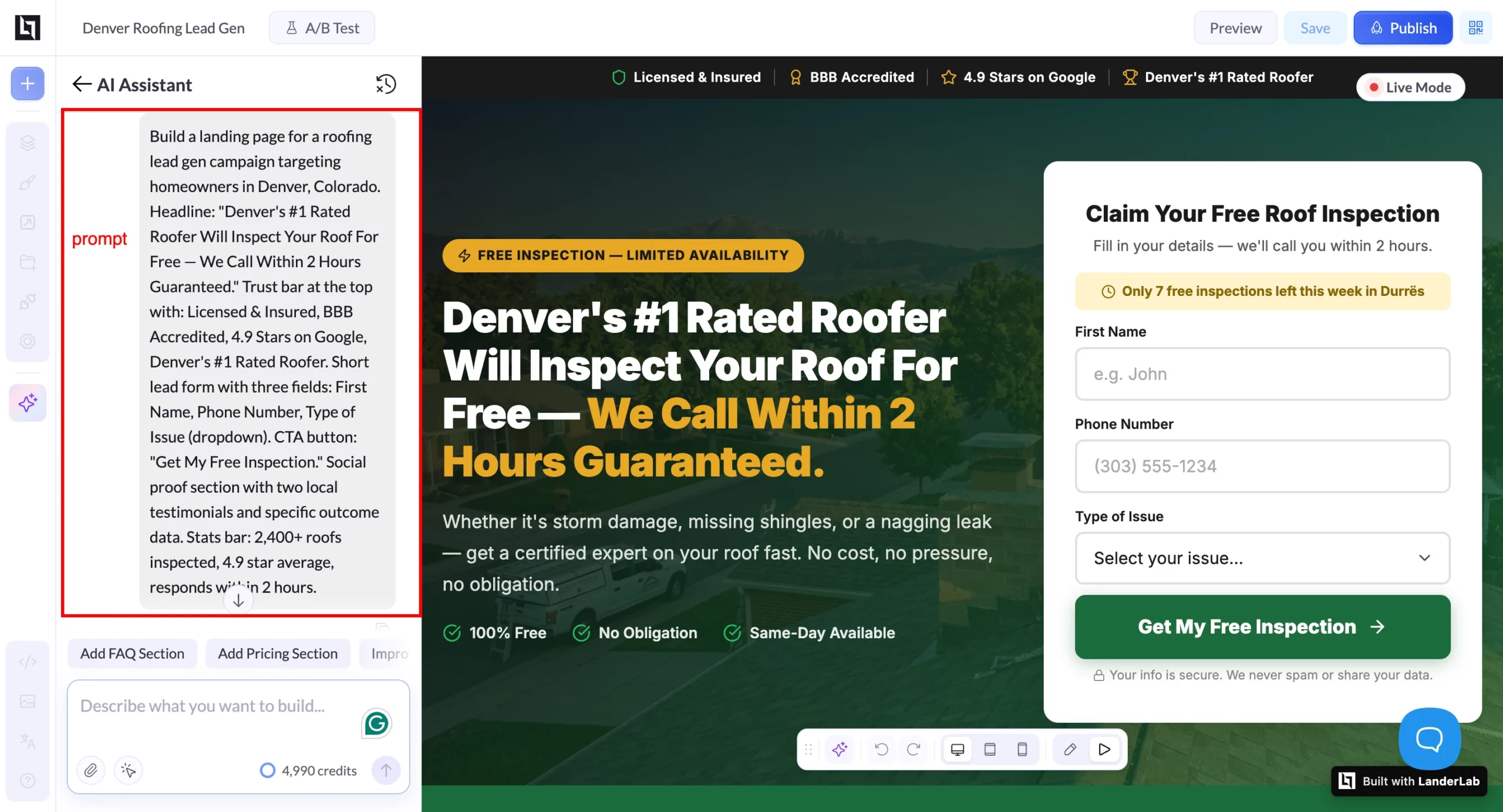
For paid traffic teams running multiple campaigns simultaneously, this means each ad set can have its own dedicated, message-matched landing page without the development overhead that made that impractical in the past.
LanderLab
Build dedicated landing pages for every paid campaign in minutes.
LanderLab’s AI builder generates landing pages and quiz funnels from a single prompt. No developer, no design brief, no waiting. Each page is message-matched to your specific ad, with built-in A/B testing and conversion tracking.
Frequently Asked Questions
What is the difference between a landing page and a website?
Should I send paid traffic to my website or a landing page?
Do I need a separate landing page for each ad?
Can a landing page hurt my SEO?
What is message match and why does it matter?
How do I build a landing page without a developer?
The Bottom Line
For paid traffic, the answer is almost always a dedicated landing page. Not because websites are bad, but because websites are designed to serve multiple audiences with multiple goals. Paid traffic visitors have one goal. The page should have one goal too.
Send brand search traffic to your website. Send everything else to a dedicated landing page that matches the ad, removes navigation, and gives the visitor exactly one thing to do.
The conversion rate difference is real. The attribution difference is real. The message match advantage is real. None of it requires a developer or a long build cycle anymore.