Retargeting Landing Pages: Why Warm Traffic Needs a Different Page
You spent money getting that visitor to your landing page. They read it, considered it, and left. Three days later, your retargeting pixel fires, and you show them an ad. They click. You send them back to the exact same page they already decided not to convert on. That is the retargeting mistake mos

You spent money getting that visitor to your landing page. They read it, considered it, and left. Three days later, your retargeting pixel fires, and you show them an ad. They click.
You send them back to the exact same page they already decided not to convert on.
That is the retargeting mistake most paid traffic teams make. Not the targeting. Not the creative. The destination.
Retargeting landing pages are built for a different psychological state than cold traffic pages.
The visitor already knows your brand. They have already seen your offer. They left without converting for a specific reason, and that reason is almost never “I have not heard of this company.” Sending them back to the same page that did not convert them the first time produces the same result the second time.
When built for the right audience segment, retargeting pages convert at 2-3x the rate of cold-traffic pages for the same offer because the audience is warmer and the page is finally matched to where they actually are in the decision process.
This article covers what retargeting landing pages are, why they differ from cold traffic pages, what each retargeting audience segment needs, and how to build them.
Why Retargeting Traffic Needs Its Own Landing Page
Cold traffic visitors arrive on a landing page knowing nothing about you. The page has to establish legitimacy, explain the offer, address objections, and ask for a conversion, all in one view, for someone who has no prior relationship with the brand.
Retargeting visitors have already done most of that work. They know the brand. They have seen the offer. They read some or all of the cold traffic landing page and still did not convert.
Showing them the same page again is not a retargeting strategy. It is a repetition strategy that produces diminishing returns.
What retargeting traffic actually needs from a landing page is different across every segment:
A visitor who reached the thank you page has already converted. They do not need to be sold the primary offer again. They need a secondary offer, an upsell, or a referral ask.
A visitor who spent three minutes on a solar landing page reading the savings estimates but did not submit the form has a specific objection. It might be pricing, legitimacy, or uncertainty about whether they qualify.
The retargeting page needs to address that specific objection rather than repeat the original pitch.
A form abandoner who got to the phone number field and stopped has a privacy concern. They need a compliance statement and a softer entry point, not the same aggressive form they abandoned.
An existing customer who clicked an ad has a completely different context from a new prospect. They need a relationship touchpoint, not an acquisition page.
One cold traffic landing page cannot effectively serve all four of these visitors.
Retargeting landing pages are built for one segment at a time, matched to the specific reason that the visitor left and the specific thing they need to see to come back.
The Four Retargeting Audiences and What Each Needs
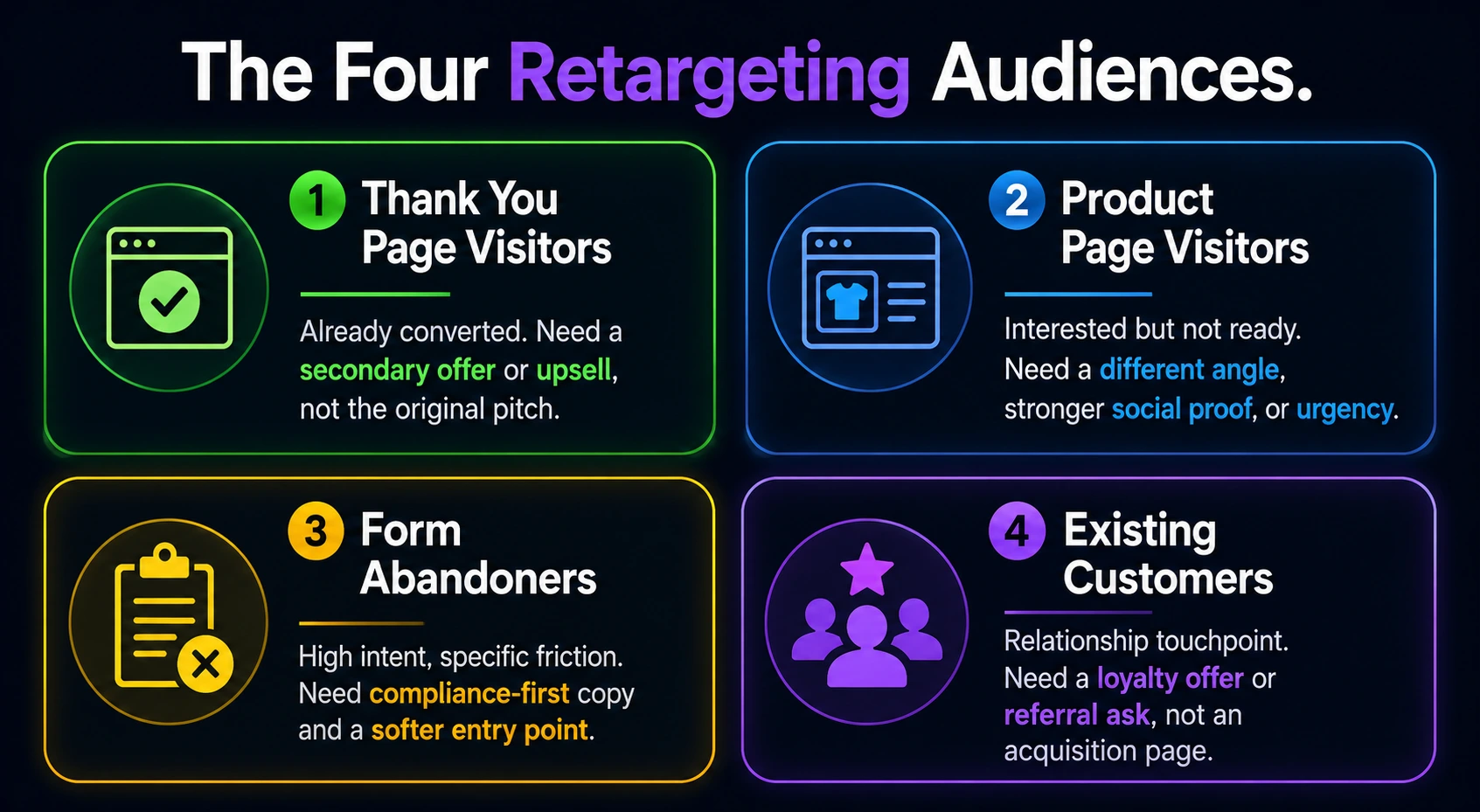
1. Thank You Page Visitors (Already Converted)
Visitors who reached your thank you page have already converted. They submitted a form, booked a call, or completed a purchase.
They are your highest-value retargeting audience because they have already demonstrated the most intent of anyone in your funnel.
The mistake most teams make here is excluding these visitors from all retargeting entirely.
Excluding this audience from prospecting campaigns makes sense, but it is the ideal target for cross-sell sequences, upsell offers, and referral campaigns.
What a retargeting landing page for this audience needs:
A completely different offer from the one they already converted on. Showing them the same solar lead gen page they already submitted is confusing and wastes budget.
The retargeting page should present a natural next step: a battery storage add-on for a solar converter, a higher-tier service for a home services lead, a related insurance product for a Medicare converter.
A tone that acknowledges the existing relationship. “Since you recently requested a roof inspection, you may also qualify for our gutter protection program” converts better than a cold acquisition page because it confirms the relationship and makes the new offer feel relevant rather than random.
2. Product or Service Page Visitors (Interested but Not Ready)
This is typically the largest retargeting segment. These visitors saw the landing page, spent time on it, and left without converting. They have demonstrated interest but not commitment.
The reason they did not convert on the first visit is almost never that the page was poorly designed. It is almost always one of three things: they needed more time to think, they had a specific unanswered objection, or they were comparison shopping and left to evaluate alternatives.
What a retargeting landing page for this audience needs:
A different angle, not a repetition of the original. If the cold traffic page led with speed (“we call within 2 hours”), the retargeting page should lead with a different dimension of the offer: social proof, price transparency, or a risk-removal offer, such as a free consultation with no obligation.
Urgency that was not present on the first visit. A limited-time offer, a specific deadline, or a scarcity signal gives the visitor who was “almost ready” a reason to decide now rather than continue deferring.
Stronger social proof. A visitor who left after reading the cold traffic page was not fully convinced.
The retargeting page can lead with testimonials and outcome data more heavily than the cold traffic page, because this visitor is past the awareness stage and into the evaluation stage.
3. Form Abandoners (High Intent, Specific Friction)
Form abandoners are the most valuable unconverted audience in any lead generation funnel. They started the conversion process and stopped. The reason they stopped is almost always specific and identifiable from session recordings.
Common abandonment points in lead gen forms: the phone number field (privacy concern), the email field following the phone number (too much personal information too fast), and any field that reveals pricing, income, or sensitive personal data before trust is established.
What a retargeting landing page for this audience needs:
A compliance statement in a more prominent position than the original page. A visitor who stopped at the phone number field had a privacy concern. The retargeting page should lead with “Your information will never be shared or sold” before anything else.
A reduced-friction entry point. A two-step form that captures name and email first, with phone number on the second step, removes the specific friction point that caused the abandonment without losing the qualification data.
A softer CTA that acknowledges the commitment is lower. “Get a free quote, no phone call required” or “See your options without talking to anyone” removes the sales call anxiety that causes many form abandoners to stop.
4. Existing Customers (Relationship Touchpoints)
Existing customers who click a retargeting ad are often doing so accidentally, but the landing page they reach is still a touchpoint in the customer relationship.
Sending them to an acquisition page designed for strangers is a missed opportunity at best and actively damaging to the relationship at worst.
What a retargeting landing page for this audience needs:
Recognition that they are already a customer. “As a [Company] customer, you have access to our referral program,” or “We noticed you’ve been with us for six months.
Here’s an exclusive loyalty offer that converts significantly better than a cold acquisition page because it acknowledges the relationship.
A secondary conversion goal appropriate to an existing customer. Referral prompts, loyalty upgrades, and complementary service offers are all appropriate. A primary acquisition CTA is not.
What Retargeting Landing Pages Include That Cold Traffic Pages Do Not
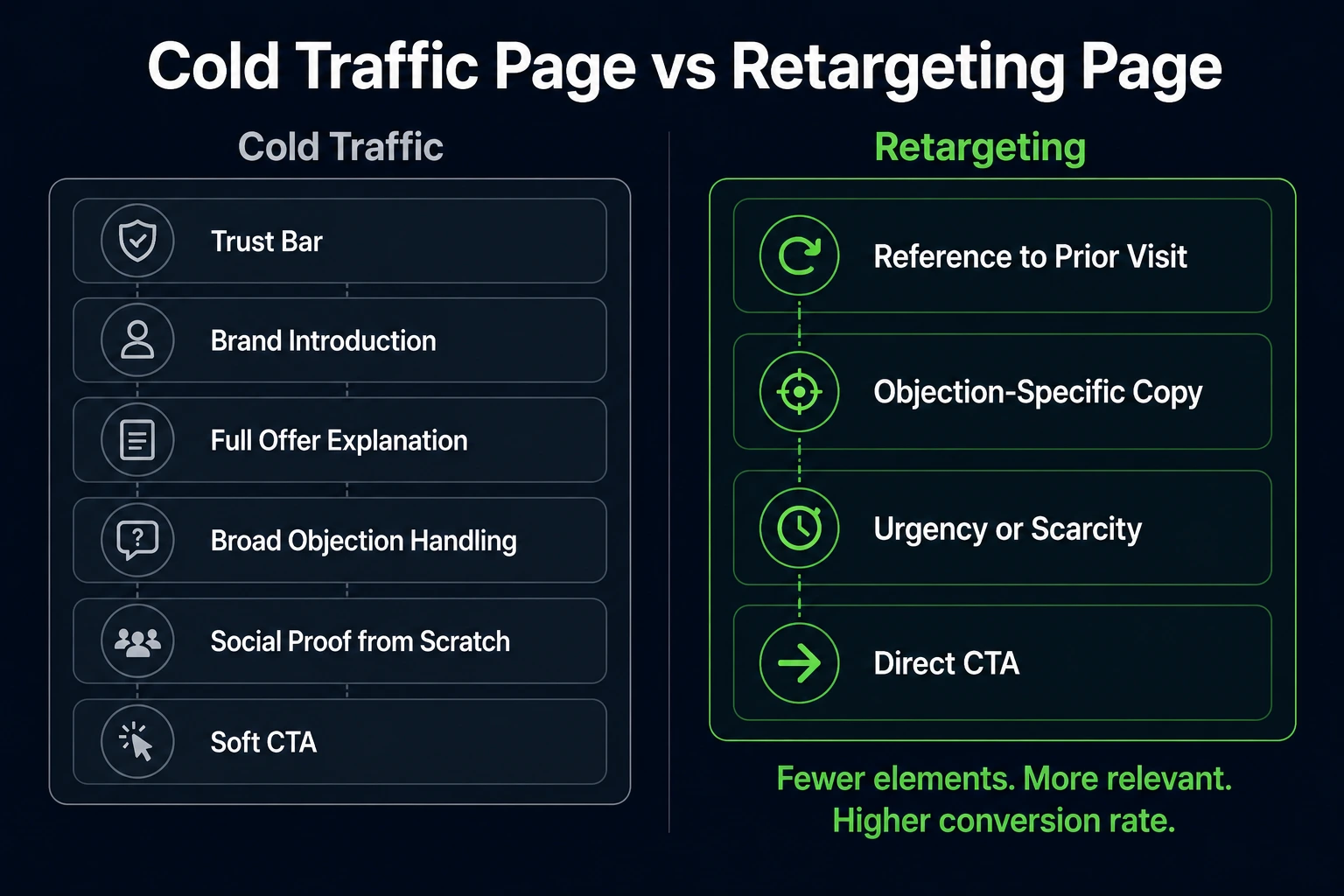
A reference to the prior visit or action. Cold traffic pages cannot reference what the visitor did before arriving because they have no prior relationship. Retargeting pages can and should. “You recently looked at our solar savings calculator” or “You started a quote last week” immediately tells the visitor that the page is relevant to their specific situation rather than a generic ad they happened to see.
Objection-specific copy. Cold traffic pages address a range of objections because you do not know which one the visitor has. Retargeting pages can be built around a specific objection because behavioral data tells you which one caused the drop-off.
A page built for visitors who abandoned the form at the phone number field addresses privacy concerns.
A page built for visitors who spent time on the pricing section but did not convert to addresses. A page built for visitors who read the testimonials but did not convert to address credibility.
Less introductory content. Trust bars, brand introductions, and category explanations are necessary for cold traffic visitors who do not know the brand.
Retargeting visitors already know all of this. Pages built for warm audiences skip the introductory layer and go directly to the offer and the objection removal.
Higher-commitment CTAs. Cold traffic pages often use softer CTAs (“see how it works,” “learn more”) to reduce friction for visitors who are still in the awareness stage.
Retargeting pages can use more direct CTAs (“claim your offer,” “book your appointment”) because the visitor is further along in the decision process, and a softer CTA actually reduces urgency rather than reducing friction.
Urgency and scarcity that feels earned. Cold traffic visitors who have never heard of your brand find urgency tactics suspicious. Retargeting visitors who already know the brand and have considered the offer makes the same urgency tactics credible because they have context.
A “limited slots available this week” message lands differently on a visitor who has been thinking about booking for three days than on a first-time visitor.
Retargeting Landing Pages by Vertical
Home Services (Roofing)
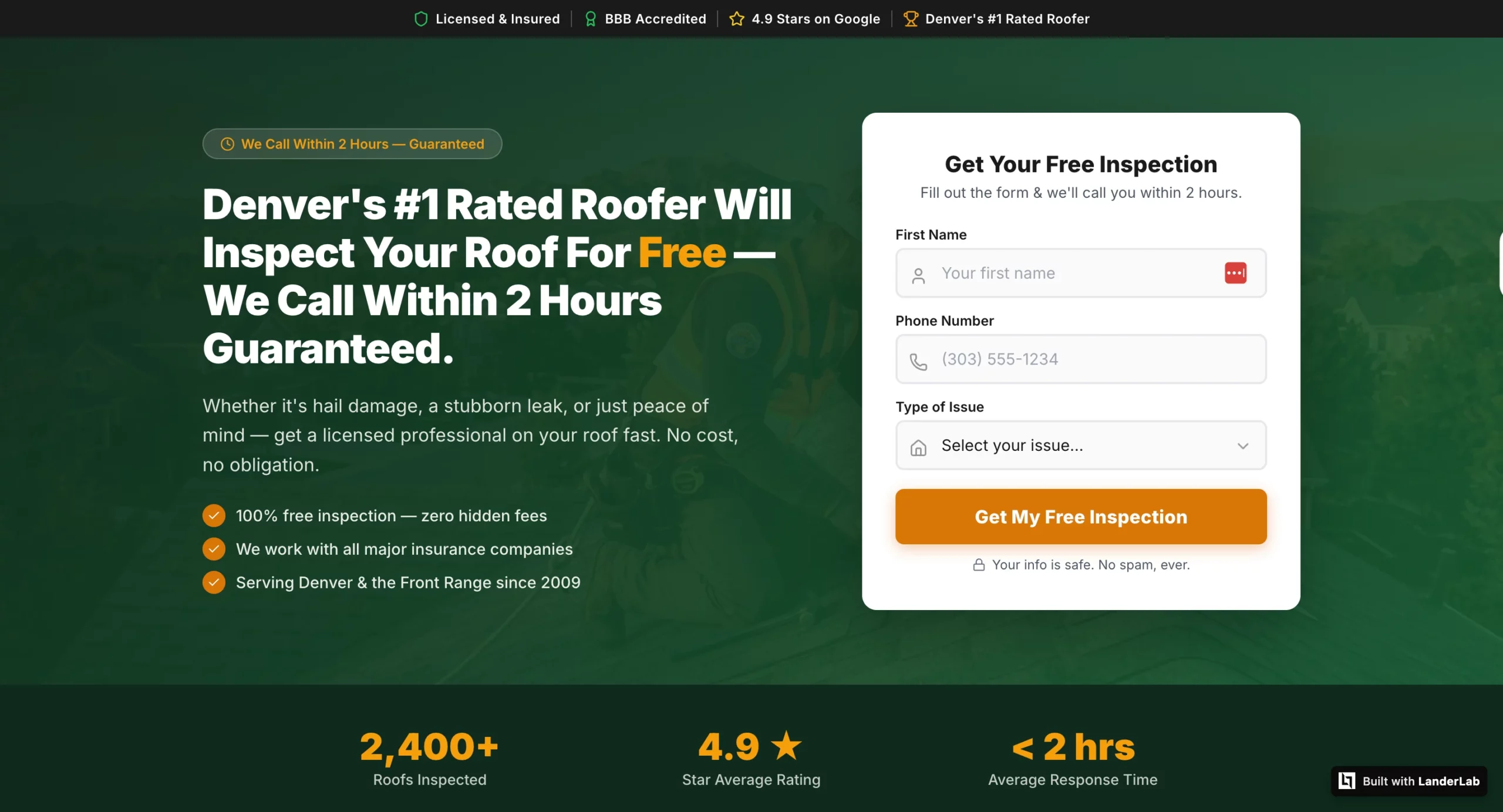
The cold traffic roofing landing page addresses legitimacy and response time because those are the two questions a first-time visitor has. The retargeting page for a visitor who saw the cold traffic page but did not convert needs a different angle.
The most effective retargeting angle for home services form abandoners is risk removal. The visitor already knows the company is legitimate and already knows about the 2-hour callback. What stopped them was usually one of two things: they were not sure the inspection was actually free with no hidden costs, or they were not ready to commit to a callback immediately.
A retargeting page that leads with “Free inspection means free. No hidden fees, no obligation to proceed, no surprise quotes” and offers a calendar booking option instead of a callback converts the second segment better than repeating the original urgency-focused page.
Solar
Solar retargeting audiences split cleanly into two groups: visitors who engaged with the savings calculator or quiz and left without submitting, and visitors who submitted the form but did not answer the follow-up call.
For the first group, the retargeting page should lead with the specific savings estimate the visitor was about to receive. If the quiz funnel captured their electricity bill before they abandoned, LanderLab’s dynamic tokens can insert that data into the retargeting page: “Based on your $280 monthly bill, your estimated annual savings are $2,100. Your consultation is still available.”
For the second group, the retargeting page should address the anxiety about the sales call directly. “Your consultation is 15 minutes. No pressure, no commitment. Your advisor will explain your options and answer questions. That’s it.” The visitor who did not answer the phone has a sales call anxiety that the original thank you page did not fully address.
Medicare and Insurance
Medicare retargeting audiences have the highest abandonment rate of any lead gen vertical because the privacy concern is strongest. A visitor who left a Medicare landing page without converting almost certainly had a concern about data privacy or about being sold to aggressively.
The retargeting page for this audience needs to lead harder on compliance than the original cold traffic page did. If the original page had a compliance statement in the header, the retargeting page should have it as the headline. “Your Medicare options are reviewed by one licensed advisor.
Your information is never shared, sold, or distributed to third parties.” As the opening line of a retargeting page converts form abandoners in this vertical better than any offer-focused copy.
How LanderLab Builds Retargeting Landing Pages
Building separate retargeting landing pages used to mean separate build cycles, separate design briefs, and separate pages to maintain. Most teams skipped it entirely because the operational overhead was too high relative to the perceived benefit.
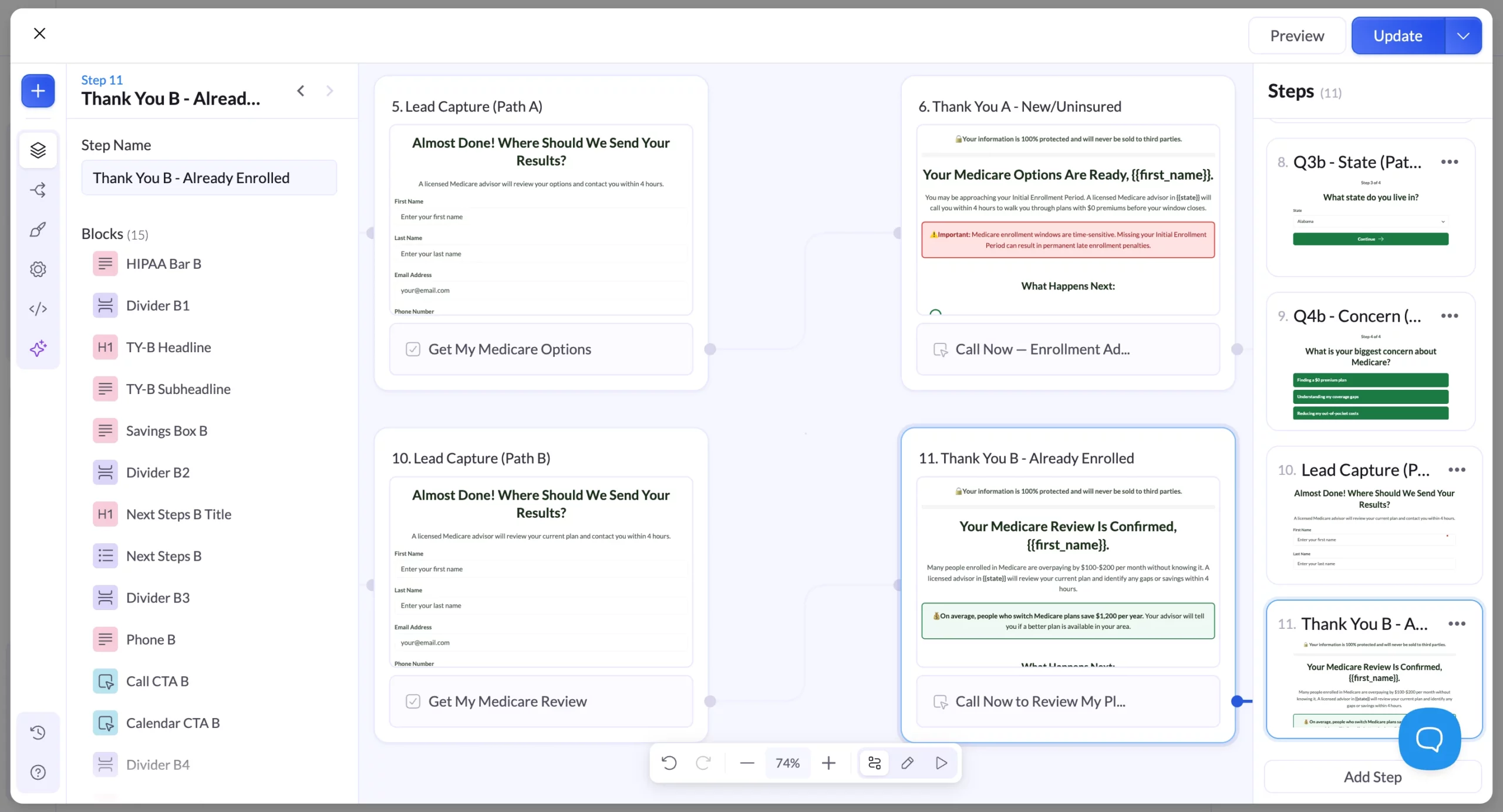
LanderLab’s AI landing page builder generates a complete retargeting page from a single prompt describing the audience segment, the specific objection to address, and the offer.
The AI produces copy, layout, form, and thank you page matched to the retargeting context without starting from scratch.
For quiz funnel retargeting specifically, LanderLab’s dynamic token system makes it possible to build a single retargeting page template that personalizes to each visitor’s quiz data.
A visitor who answered that their electricity bill is $280 and then left without converting sees a retargeting page that references their specific bill amount and savings estimate.
A visitor who answered $400 sees different numbers. One page template, personalized output for every visitor.
The conditional routing feature handles audiences that split into different segments within the same retargeting campaign.
A Medicare retargeting campaign can route form abandoners to the compliance-first page and existing leads who did not answer the call to the softer re-engagement page, without building two separate campaigns.
LanderLab
Build retargeting landing pages matched to each audience segment.
LanderLab generates complete landing pages and quiz funnels from a single AI prompt. Dynamic tokens personalize retargeting pages to each visitor’s quiz data. Conditional routing sends different segments to different pages within the same funnel.
The Bottom Line
Retargeting landing pages are not a refinement of your cold traffic landing pages. They are a different type of page built for a different psychological state, a different objection, and a different position in the decision process.
The visitor who left your roofing page without converting does not need to see your trust bar and response time promise again. They have already processed that information.
They need to see whatever specific thing they were missing that prevented them from converting the first time.
The teams that build dedicated retargeting landing pages consistently see higher conversion rates from retargeting campaigns, not because retargeting is inherently more efficient, but because the page is finally matched to the audience.
The same principle that makes message match work for cold traffic works for retargeting: the page that addresses exactly where the visitor is in the decision process converts better than the page that addresses where you wish they were.